


WELCOME TO THE AUDIOGUIDE
LISTEN TO THE INTRODUCTION TO THE EXHIBITION
SELECT ONE OF THE ARTWORKS



Welcome to FLOWERS
A note from artist Daniel Salvi
Welcome to FLOWERS, by Daniel Salvi.
This exhibition is conceived as a multisensory experience. Each visual work is accompanied by a corresponding art perfume, created in collaboration with perfumer Riccardo Barazzetta. For this reason, after each description, you will also find a brief note dedicated to the associated fragrance. To fully appreciate this journey, we invite you to collect the scent testers from the desk before your visit.
The works are also accompanied by an original soundtrack composed especially for this exhibition.
The voice you are hearing is mine — I am Daniel Salvi, the artist behind this show. FLOWERS is the new chapter of my traveling, multisensory exhibition project, Goddesses & Muses, or Dee e Muse. This series is devoted to the female figure as a vital and universal archetype of the human condition. Each work is created through a mixed digital art process that combines, according to necessity, photography, artificial intelligence, digital painting, and photo retouching.
This chapter is entirely dedicated to the floral element, to the return of spring, and to the idea of rebirth. Here, the flower is not a simple ornament, but part of an ancient language used for millennia to express what words often cannot: love, family, friendship, memory, connection.
For this reason, each work is conceived as an embodiment of the flower it represents: a nymph who gives human form to its meaning. Unlike many of my works, often created as unique pieces, the works in FLOWERS belong to the rarer realm of my limited editions. All the works on display are not only available for acquisition, but also to be given as gifts, making a feeling visible, just as one offers a flower.
My heartfelt thanks go to Quadruslight, a pioneering project in backlit art, with whom we created the exhibition’s central work. I would also like to remind you that this exhibition supports Colors for Peace, an association that promotes cultural projects for children around the world on the theme of peace.
I wish you a happy spring, and a wonderful visit.

Daniel Salvi (B. 1994)
The Flower of Love
Dimensions
30x30 cm (unframed)
20x20 cm (picture)
Description
Mixed Media Digital Art
Fine Art Print on cotton paper
in archival protective mat.
Signed by the artist (printed, lower right)
Titled, numbered and signed by hand
Sold Unframed
Edition
Limited Edition of 50
Year
2025
Price
Upon Request
The Red Rose
Deep love, passion, devotion.
A young nymph with long copper-red hair emerges from a dense tangle of red, coral, and ivory roses. Her half-closed eyes and parted lips give the figure a suspended expression, somewhere between surrender, desire, and contemplation. The flowers brush against her, intertwine with her, and seem to grow from her own body — or perhaps to have just generated her.
This work is dedicated to the red rose, a flower cultivated all over the world, with origins especially in Asia, and for centuries linked to the idea of absolute love and desire. It is one of the most symbolically rich flowers in the cultural history of the West: in the ancient world it was associated with Aphrodite, goddess of love; later, in Christian symbolism, it became the Rosa Mystica, linked to the Virgin. In art history, the red rose has represented desire, passion, and that intense beauty which can vanish in an instant.
The nymph who embodies it holds this very tension: the idea that to love means to choose, to desire deeply, and to accept the vulnerability that every true bond carries within it. Passion here is not a simple feeling, but a destiny embraced without fear.
Comment on the Art Perfume, by Riccardo Barazzetta:
Undisputed protagonists of women’s perfumes and not only, roses – particularly the tawny variety – have always been an emblem of passionate love. Their aroma can be reconstructed from six basic molecules in countless facets, but ultimately, they are always appreciated for their characteristic sweet and full-bodied scent.
Precisely for this reason, the rose aroma is also an often overused note and easily risks becoming overwhelming if not used sparingly.
Although it remains the main ingredient of this work, it has been complemented by a diverse list of supporting players: the accords composing the perfume thus transform into a single, uninterrupted sequence of nuances of the same ingredient, which remains central without taking over the entire scene.

Daniel Salvi (B. 1994)
The Flower of Life
Dimensions
30x30 cm (unframed)
20x20 cm (picture)
Description
Mixed Media Digital Art
Fine Art Print on cotton paper
in archival protective mat.
Signed by the artist (printed, lower right)
Titled, numbered and signed by hand
Sold Unframed
Edition
Limited Edition of 50
Year
2025
Price
Upon Request
The White Lily
Purity, innocence, devotion, family.
A presence emerges from the darkness, luminous and solemn: a young nymph whose hair floods the image, while imposing white lilies open around her face, surrounding her like a silent and protective force. Her steady gaze does not seek seduction; it seems instead to guard a quiet form of strength, belonging, and origin.
This work is dedicated to the white lily, one of the most iconic flowers in Western tradition. Already in the ancient Mediterranean world it symbolized purity, regeneration, and renewal; in Christian tradition it later became the sacred flower of the Annunciation, offered by the archangel Gabriel to the Virgin Mary, and therefore linked to the idea of motherhood, care, and life. In the history of art, the lily thus travels across the centuries as an image of birth, belonging, and protection.
In this reinterpretation, the lily therefore also speaks of roots and family. It is the place one comes from, or the one one chooses to return to. The nymph who embodies it preserves precisely this quality: a silent but central presence, able to sustain, welcome, and hold things together.
Comment on the Art Perfume, by Riccardo Barazzetta:
The aroma of lily was reconstructed here starting from the florol molecule. Since the latter has an elusive odor, I decided to use it as the sole ingredient in the heart accord and the dominant note of the perfume, covering a third of the entire aromatic spectrum. To maintain this approach in the construction of the aroma, the rest of the perfume consists of a volatile top note of bergamot and a subtle base of amber, woods and musks.

Daniel Salvi (B. 1994)
The Flower of Friendship
Dimensions
30x30 cm (unframed)
20x20 cm (picture)
Description
Mixed Media Digital Art
Fine Art Print on cotton paper
in archival protective mat.
Signed by the artist (printed, upper left)
Titled, numbered and signed by hand
Sold Unframed
Edition
Limited Edition of 50
Year
2025
Price
Upon Request
The Sunflower
Adoration, loyalty, solar strength, friendship.
The young nymph rests with her eyes closed, wrapped in a tangle of leaves and luminous sunflowers. The yellow petals emerge from the dark green like small burning suns, while the figure’s serene expression conveys quiet, surrender, and trust. Here, light does not strike the scene from outside: it seems to arise from the flowers themselves, as if the sunflower were holding a form of human warmth.
This work is dedicated to the sunflower, a flower now universally associated with the idea of sun, energy, and warmth. In the history of art, its name inevitably recalls the famous series of Sunflowers by Vincent van Gogh, perhaps the best-known floral cycle in all of Western painting. Those flowers were also painted to welcome his friend Paul Gauguin to the Yellow House in Arles: even then, the sunflower became a gift, a sign of welcome, and the symbol of an intense, creative, almost salvific friendship.
For this reason, in the FLOWERS series, the sunflower becomes the flower of friendship: a presence that supports, warms, and illuminates even in the most difficult moments. It is a complicity that consoles, a closeness that asks for nothing and yet remains. Friendship thus appears as an emotional alliance, a shared ray of light that makes the world more inhabitable.
Comment on the Art Perfume, by Riccardo Barazzetta:
The sunflower doesn’t own a real aromatic outline. Creating this perfume, my first idea was to give it a “natural” scent, green and herbaceous: a cosmetic transposition of leafy and earthy scents. However, a too “raw” reconstruction would have produced a too far result from every perfumery application.
I therefore decided to abandon the olfactory reconstruction and develop a second formula, referring back to the concept of “sunshine” and the underlying theme of friendship presented in the respective painting, for a result closer to the world of cosmetics.
The perfume opens with citrus notes of bergamot and mandarin. Neroli and ylang-ylang in the heart – accompanied by jasmine – reflect the female protagonist of the drawing through a contrast of pungent aromaticity and light sweetness. A more nuanced progression can be found in the base notes. The cleanliness of white musk fades into the creaminess of tonka bean and ends in the final, darker element of sandal.

Daniel Salvi (B. 1994)
The Throne of Flora
Dimensions
200x150 cm
Description
Mixed medium digital art,
Printed on backlit textile
with LED backlighting system
by Quadruslight
Edition
Unique Piece
Year
2024
Price
Upon Request
The Marygold
Healing, resilience, gentle light
Three young female figures sit gathered in a flowering field, so close that they seem like one body divided into three presences. Crowns of pale and orange flowers merge with their copper-red hair, while their light garments, barely stirred, make the scene feel suspended between stillness and apparition. The central figure holds the composition like a silent axis; the two beside her lean toward her in a gesture that is intimate, ritual, and regal all at once. Around them, the field of marigolds and white flowers is not merely background: it is the very throne upon which nature crowns its sovereign.
This work stages Flora, the Roman goddess of blooming, spring, and the generative force of nature. In the history of Western art, Flora crosses the centuries as an image of abundance, rebirth, and fertile grace: from ancient painting to the Renaissance, and memorably in Botticelli, where her flower-clad body becomes almost a direct manifestation of spring itself. Here, however, Flora does not appear as a single isolated figure: the two nymphs at her sides join her in a sort of natural trinity. Together, the three girls embody the joy of life, fertility, and the power of blossoming, transforming the goddess into a choral presence — broader and more human.
The work is inspired in particular by marigolds, flowers linked to sunlight, warmth, constancy of blooming, and, in many folk traditions, also to protection and vitality. For this reason, the scene speaks not only of beauty, but of returning energy, cyclic renewal, and a gentle, unstoppable force. The throne is not a symbol of domination, but of fullness: here royalty coincides with the ability to generate, nourish, and make things bloom again.
In this image, femininity is not idealized as distant perfection. It is, rather, a form of vital power: creative, fragile, and at once untamable. The Throne of Flora, from which all the other flower artworks seem to radiate and almost take shape, thus becomes a hymn to rebirth and to that deep grace that continues to re-emerge, season after season, in every form of life.
Comment on the Art Perfume, by Riccardo Barazzetta:
Composing “Flora” was the most ambitious work of this exhibition. The accompanying drawing represents the very concept of “florality”, so my first idea was to create a range of floral aromas, aiming to harmonize together as many of them as possible. This initial hypothesis was quickly abandoned, given its infeasibility.
In order to create a perfume so complex with its infinite possibilities and aromatic nuances, I preferred to face the work analytically and minimally, focusing only on the flowers most used in women’s perfumery. I thus compiled a list of ingredients for a perfume with exclusively floral accords, which best represented the concept of “feminine flower”.
Since the related drawing depicts three lightly-dressed female subjects in a lush field filled with flowers reminiscent of marigolds, I gave greater prominence to the flowers associated with the warm seasons and the so-called “colourful” ones, which are usually also the most aromatic.
In order of importance, there are: rose, jasmine, orris and ylang-ylang, all enveloped by the “evergreen” note of neroli. The additional molecule of hedione is placed at the heart of the perfume as a “medium and neutral” floral note, to which all the others are linked.

Daniel Salvi (B. 1994)
The Flower of Thought
Dimensions
30x30 cm (unframed)
20x20 cm (picture)
Description
Mixed Media Digital Art
Fine Art Print on cotton paper
in archival protective mat.
Signed by the artist (printed, upper left)
Titled, numbered and signed by hand
Sold Unframed
Edition
Limited Edition of 50
Year
2026
Price
Upon Request
The Pansy
Thoughtfulness, remembrance, quiet affection.
A young nymph with dark hair barely emerges from the thickness of the vegetation, as if held back by an inner garden. Around her face, small pansies in shades of purple and lilac light up; some brush her cheek, others intertwine with her hair and chest in a minute, insistent pattern. Her gaze is lowered, her lips slightly parted, her expression absorbed. She is not a figure who offers herself immediately: she seems inhabited by an absent presence, by something that keeps returning to the mind.
This work is dedicated to the pansy, a flower that in Europe has for centuries carried meanings tied to memory, reflection, and emotional persistence. Even its English name suggests it: pansy derives from the French pensée, meaning “thought.” In literary tradition, this association became famous in Shakespeare, when Ophelia says in Hamlet: “and there is pansies, that’s for thoughts,” linking the flower to what one keeps thinking about, to what one cannot let go. In the nineteenth century, within the Victorian language of flowers, it became one of the most widely used signs for telling someone: you are in my thoughts.
For this reason, here the pansy does not represent a stable bond like love, family, or friendship, but introduces a new constellation of works: that of messages. It is the flower of what remains in the mind when a presence has withdrawn, of emotional memory returning insistently. The nymph who embodies it therefore holds a gentle melancholy, the visible form of something that cannot be retained, yet never ceases to accompany us.
Comment on the Art Perfume, by Riccardo Barazzetta:
In respect of the painting subject, “Accordo di Viola” seeks to recreate a calm, sensual, and expectant (amorous) mood. To do so, fruity, citric, and – by extension – overly pungent notes were avoided in favor of a moderate sweetness.
The top notes therefore eschew citrus in favor of green, herbaceous notes. The sweetness of geranium and violet in the heart is tempered by the “white” scent of orris. The borderly sensual spicy and gourmand base closes the perfume with an accord of cocoa, cardamom, white lilac and honey.

Daniel Salvi (B. 1994)
The Flower of Peace
Dimensions
30x30 cm (unframed)
20x20 cm (picture)
Description
Mixed Media Digital Art
Fine Art Print on cotton paper
in archival protective mat.
Signed by the artist (printed, lower right)
Titled, numbered and signed by hand
Sold Unframed
Edition
Limited Edition of 50
Year
2026
Price
Upon Request
The Magnolia
Dignity, perseverance, nobility, forgiveness.
A young nymph with long copper-red hair emerges from a dense tangle of red, coral, and ivory roses. Her half-closed eyes and parted lips give the figure a suspended expression, somewhere between surrender, desire, and contemplation. The flowers brush against her, intertwine with her, and seem to grow from her own body — or perhaps to have just generated her.
This work is dedicated to the red rose, a flower cultivated all over the world, with origins especially in Asia, and for centuries linked to the idea of absolute love and desire. It is one of the most symbolically rich flowers in the cultural history of the West: in the ancient world it was associated with Aphrodite, goddess of love; later, in Christian symbolism, it became the Rosa Mystica, linked to the Virgin. In art history, the red rose has represented desire, passion, and that intense beauty which can vanish in an instant.
The nymph who embodies it holds this very tension: the idea that to love means to choose, to desire deeply, and to accept the vulnerability that every true bond carries within it. Passion here is not a simple feeling, but a destiny embraced without fear.
Comment on the Art Perfume, by Riccardo Barazzetta:
Undisputed protagonists of women’s perfumes and not only, roses – particularly the tawny variety – have always been an emblem of passionate love. Their aroma can be reconstructed from six basic molecules in countless facets, but ultimately, they are always appreciated for their characteristic sweet and full-bodied scent.
Precisely for this reason, the rose aroma is also an often overused note and easily risks becoming overwhelming if not used sparingly.
Although it remains the main ingredient of this work, it has been complemented by a diverse list of supporting players: the accords composing the perfume thus transform into a single, uninterrupted sequence of nuances of the same ingredient, which remains central without taking over the entire scene.

Daniel Salvi (B. 1994)
The Flower of Gratitude
Dimensions
30x30 cm (unframed)
20x20 cm (picture)
Description
Mixed Media Digital Art
Fine Art Print on cotton paper
in archival protective mat.
Signed by the artist (printed, lower right)
Titled, numbered and signed by hand
Sold Unframed
Edition
Limited Edition of 50
Year
2026
Price
Upon Request
The Hydrangea
Gratitude, understanding, deep emotion.
A young nymph rests blissfully, almost submerged beneath great clouds of blue petals. The hydrangeas gather around her face like a gentle thought returning again and again. The soft blue of the flowers, immersed in brown and shadowy tones, gives the image a collected quietness, as if gratitude here were not enthusiasm, but deep recognition: something one feels afterwards, when one truly understands what has been received.
This work is dedicated to the blue hydrangea, a flower that in many contemporary traditions, and especially in Japan, is linked to sincere gratitude, heartfelt emotion, and also emotional reparation. This association derives from a well-known legend, according to which an emperor offered hydrangeas to express regret and gratitude toward the woman he had neglected because of his duties.
Its very form reinforces this reading. The hydrangea does not present itself as a single flower, but as a constellation of small blossoms gathered into one mass. For this reason, it lends itself well to representing gratitude: a feeling made of many things together — memory, received care, shared time, protection, presence. It appears strongly in botanical art, in the decorative arts, and especially in Japanese art, where it is also associated with the rainy season and with a contemplative sensibility.
Gratitude thus becomes a silent form of inner light: not a debt toward someone, but the awareness that something good has reached us and changed us.
Comment on the Art Perfume, by Riccardo Barazzetta:
The hydrangea flower doesn’t have a recognizable scent for cosmetic purposes. Therefore, I decided to creatively reconstruct it, pursuing the idea of a faint, feminine scent, as presented in the related drawing.
The result is a highly nuanced composition, but within it, one can recognize aquatic notes, green notes, white flowers and musks.

Daniel Salvi (B. 1994)
The Secret Garden
Dimensions
21x29.7 cm (unframed)
15x22.5 cm (picture)
Description
Mixed Media Digital Art
Fine Art Print on cotton paper
in archival protective mat.
Signed by the artist (printed, lower left)
Titled, numbered and signed by hand
Sold Unframed
Edition
Limited Edition of 25
Year
2025
Price
Upon Request
The Hidden Haven
A place of beauty where we can return.
We have reached the final work of the exhibition.
A young woman, immersed in a dense tangle of leaves, places one hand on her chest in a gesture of recollection, almost of protection. The image is quiet, essential. Here there is no blooming, but a sense of refuge.
The Secret Garden closes the exhibition like a final threshold. After the flowers of bonds and the flowers of messages, this work focuses on the idea of an inner place to which one may return. A garden not as a real space, but as a condition of the soul: an invisible place in which the social mask falls away, fragility is not exposed to judgment, and what remains can finally breathe.
The image comes from a personal memory. In the first days of spring in Berlin, on an evening still cold, walking aimlessly through the darkness turned into a realization: I was not searching for a place, but for a sense of warmth and salvation that could not be found outside, but only within me. From that intuition came the idea of the secret garden: an inner space that reveals itself only when we accept to pass through our vulnerability without defenses.
For this reason, although it is not linked to a specific flower, this work is deeply connected to FLOWERS. The whole exhibition can be read as a series of access points to this hidden place: the flowers, with their meanings, the perfumes, the music, the nymphs and their gazes are only different thresholds toward a space of recognition, consolation, and memory. The Secret Garden gathers all this and returns it in a more intimate form.
In this image, peace does not arise from the absence of pain, but from the possibility of being welcomed without having to prove anything. Vulnerability is not weakness: it is a protected truth. And the secret garden thus becomes the symbol of that rare closeness — with oneself, with a memory, with another human presence — capable of dissolving emotional loneliness and restoring breath.
Comment on the Art Perfume, by Riccardo Barazzetta:
The perfume “Secret Garden”, like its eponymous drawing, is directly related to the previously exhibited work “Rain”, whose exclusive subject is a weeping woman wrapped in vines filling the canvas under a partially cloudy sky.
In this new work, the central element of melancholic weeping is overcome; the subject’s attention is shifted to an approaching male figure – whose presence is also emphasized in the accompanying music.
I therefore decided to create this new perfume by listing the ingredients of the previous work, “Rain”. However, I replaced the aquatic notes, representing the weeping of the past subject, with additional green notes. Furthermore, male notes of indole and vetiver were added to the base, representing the missing individual about to appear.

Light that illuminates form,
art that illuminates space.
Discover the Technology behind
"The Throne of Flora"
Quadruslight is the world's first project dedicated exclusively to the backlighting of artistic works. Painting, photography, and digital art merge and transform with light, imbuing the works with a new vitality.
A pioneering journey where proposals arise from collaborations with teams of industry professionals and selected artists, for projects in the fields of architecture and design, events, and artistic and cultural performances.
Quadruslight seeks to redefine the boundary between the artwork and its surrounding environment. Backlighting is not just a technical device, but becomes a true artistic medium that alters the perception of color and depth.

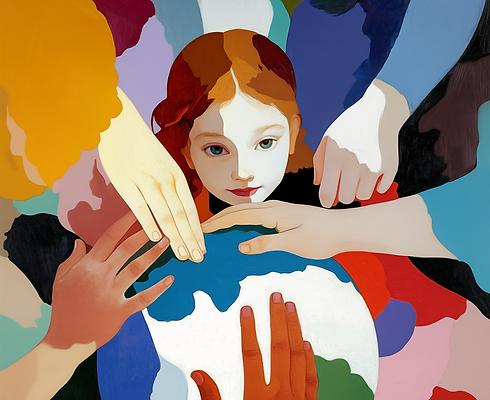
A gesture that supports peace
Make a donation to Colors for Peace, to receive a collectible item connected to the exhibition.
This exhibition supports Colors for Peace, an international organization that promotes cultural and educational projects for children centered on peace.
During the visit, it is possible to make a donation in support of the association and receive a selection of collectible items connected to the exhibition.
A way to take home a memory of FLOWERS, while also making a concrete contribution to a message of peace, creativity, and dialogue among peoples.
Discover More


SIGN UP FOR DANIEL SALVI NEWSLETTER
Receive news on upcoming artworks, exhibitions,
and the evolving world of the Art of Daniel Salvi.
SUBSCRIBE
Contacts
Daniel Salvi
Viale Giovanni XXIII n.21
20014 Nerviano
(Milan, Italy)


© 2023-2026 Daniel Salvi - Goddesses & Muses - All Rights Reserved.